
RESEARCH
Insects represent one of the most diverse, numerous and ubiquitous group of animals on Earth. With pollination of more than 75% of all crop species, nutrient recycling, and transport, they play pivotal roles in maintaining ecosystem health. Economic value of insect driven services is estimated at $33 trillion USD, which is a staggering 38% of global GDP. The dependency of ecosystems and humanity on them, makes insect conservation of critical importance.
Alarmingly, dramatic insect declines have been documented in a number of studies raising concerns about the potential ecological and economic impacts of losing such a critical ecosystem component. Although the causes of this 'insect armageddon' are complex and not fully understood, factors such as habitat loss, pesticide use, climate change, and light pollution are often considered the most probable contributors.
In the most recent and comprehensive meta-analysis, the geographical bias in long-term insect monitoring data is indisputable. This is because gathering standardized and quantitative data on natural insect communities is time-consuming, labor-intensive, and requires large amounts of sustained funding that can rarely be met by conventional conservation-research funds. Technological and computational advances in remote sensing provide potential new solutions to this global challenge.
My research has focused on understanding the processes driving spatio-temporal variation in insect communities. Given the challenges of studying hyper-diverse insect groups in nature, a major focus of my research is to develop innovative methods to make large-scale, long-term insect monitoring feasible. To do this, I integrate cutting edge technology, such as Radars and computer vision, with advances in Artificial Intelligence and deep learning.
Drivers & Repercussions of UK Insect Declines
-
Despite growing public concern, there is remarkably little hard evidence of general, cross-taxon insect declines in the UK or abroad.
-
In DRUID, we will bring together the widest possible set of standardised monitoring data to assess the drivers of change in terrestrial and aquatic insect populations and communities
-
You may read more about our ongoing work at DRUID and BioDAR

Hawkmoths of Eaglnest Wildlife Sanctuary - An Inventory
-
The rate limiting step in studies of tropical insect diversity is specimen identification (Brehm et al. 2003; Brehm et al. 2016), which may not even be possible at the level of species without DNA-based identifications for many groups and may lead to erroneous measures of diversity (Brehm et al. 2016).
-
To study the hyper-diverse and hyper-abundant group in eastern Himalaya, we are developing extensive digital libraries and automated species classification tools. Here we present a comprehensive photo gallery (along with the keys used for species delineation) of over 70 hawkmoth morphospecies which were encountered during my doctoral work in Eaglenest Wildlife Sanctuary.
-
This work is part of a much larger biodiversity project to investigate patterns in distribution of many other taxa (ongoing projects on other moth families, frogs and ants)


Photogrammetric method for obtaining morphological traits of free-ranging moths
-
In this work, we present a rapid, simple, accurate, and inexpensive morphometric method targeting thousands of free-ranging insects attracted to light screens using images taken without collecting a specimen or even constraining the individual in any manner.
-
The method requires only inexpensive, off-the-shelf, consumer equipment, and freely available programming (R statistical language) and image processing (ImageMagick) tools.
-
We demonstrate the efficacy of the method using a dataset of 3675 images of free-ranging hawkmoths (Lepidoptera:Sphingidae) imaged in natural repose on a screen.
-
The method is particularly suited for studies which require multi-epoch, multi-locate sampling like investigations into ecosystem stability, climate change, and community assembly, and we are currently working on making this compeletly automated.

-
We compared Bergmann’s patterns for endotherms (Aves) and ectotherms (Lepidoptera: Sphingidae) along a same 2.6 km elevational transect in the eastern Himalayas.
-
Hawkmoths exhibited positive Bergmann’s pattern at the intraspecific and abundance-weighted community scale. Contrary to this, birds exhibited a strong converse-Bergmann’s pattern at interspecific and community scales, both with- and without-abundance.
-
Overall, all metrics which incorporate local traits and/or species abundances show stronger correlations than when this information is lacking.
-
The multiplicity of patterns at a single location provides the opportunity to disentangle the relative contribution of individual- and species-level processes by integrating data across multiple nested taxonomic scales for the same taxa.

-
We investigated some aspects of hawkmoth community assembly at 13 elevations along a 200-2770 m transect in the eastern Himalayas, a little studied biodiversity hotspot of global importance.
-
The trait distribution of constituent species turned out to be non-random subsets of the community trait distribution, providing strong evidence for internal filtering in all elevational communities.
-
On average, a species occupied as much as 50-75% of the total community trait space; yet the T-statistic metric for internal filter was sufficiently sensitive to detect a strong non-random structure in the trait distribution.

Change in species relative abundance profiles along a 2600 m elevational gradient: Consistency in patterns or mechanisms?
-
The distribution of individuals across species, also known as Species Abundancen can be plotted in a variety of ways to facilitate visual comparisons amongst communities.
-
We have shown that evenness of species abundances within a community decreases with elevation for both hawkmoth and birds.
-
The decline in evenness was consistent across multiple measures including parameters from models (e.g. standard deviation of a Log-normal fit), as well as model-independent metrics such as the width of the octave binned species abundance distributions, slope of rank-abundance curves and Pielou's evenness index.
-
High evenness has been previously observed in stable, more productive ecosystems with high species richness and more resource/niche partitioning (like at low elevations and latitudes), whereas low evenness is linked to unstable, variable and less productive environments where few species dominate (like at high elevations and latitudes).


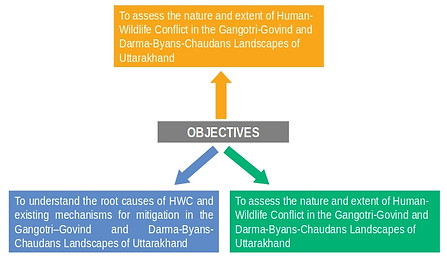
Comprehensive Human-Wildlife Conflict (HWC) Management Strategy in select Districts / Landscapes of Uttarakhand
-
As part of my first postdoctoral research, I worked on a project entitled “Comprehensive Human -Wildlife Conflict (HWC) management strategy in select districts / landscapes of Uttarakhand”, or the HWC-Component which was carried out by the Wildlife Institute of India (WII), Dehradun,
-
The work was part of the much larger “SECURE” Himalaya project (“Securing Livelihoods, Conservation, Sustainable use and Restoration of High Range Himalayan Ecosystems”), is implemented in four states of the Indian Himalayan Region (IHR) namely, Jammu & Kashmir, Himachal Pradesh, Uttarakhand and Sikkim.
-
With financial support from the GEF (Global Environment Funds), the project is an integrated approach of MoEF&CC and United Nations Development Programme (UNDP) towards conservation of high-altitude biodiversity and reducing dependency of local communities on natural ecosystems and aims to support the local communities to effectively promote sustainable land and forest management in alpine pastures and forests in high range Indian Himalayan ecosystems that secure sustainable livelihoods and ensures conservation of globally significant biodiversity and threatened species.


PUBLICATIONS
Mungee, M., Pandit, R., & Athreya, R*. (2023). Functional and phylogenetic diversity to assess deterministic community assembly processes along an East Himalayan elevational gradient for birds (In Review; Oecologia)
Maitra A., Mungee M., Pandit R., Athreya R.*, (2023) Tropical montane gradients elucidate the contributions of functional traits to competitive and environmental fitness, (Under review; available on bioRxiv)
Mungee M., S. Sathyakumar* (2022) Human-Wildlife Conflict in the Trans and Northwest Himalaya: A Review; Proceedings of Workshop on Forestry Research, Sustainable Forest Management and Livelihood; Himalayan Forest Research Institute; Indian Council of Forestry Research & Education); Conifer Campus, Panthaghati, Shimla-171013, (H.P)
Mungee, M.*, & Athreya, R. (2021a). Intraspecific trait variability and community assembly in hawkmoths (Lepidoptera: Sphingidae) across an elevational gradient in the eastern Himalayas, India. Ecology and evolution, 11(6), 2471-2487.
Mungee, M.*, Pandit, R., & Athreya, R. (2021b). Taxonomic scale dependency of Bergmann’s patterns: a cross-scale comparison of hawkmoths and birds along a tropical elevational gradient. Journal of Tropical Ecology, 37(6), 302-312.
2020
Mungee, M., & Athreya, R*. (2020). Rapid photogrammetry of morphological traits of free‐ranging moths. Ecological Entomology, 45(5), 911-923.
Sathyakumar, S.*, Mungee, M., Pal, R., (2020) Biogeography of the Mountain Ranges of South Asia. Encyclopedia of the World’s Biomes, vol. 1. Elsevier, pp. 543–554. ISBN: 9780128160961